Does beef tallow clog pores? For most people, no. Especially with a thin layer of a well-formulated balm. Comedogenic rating lists are a blunt tool. Faces are not rabbit ears. Most people do fine with a thin layer. If your T-zone runs oilier, just start smaller.
That is the honest version. Online you usually get extremes. Neither helps a real face. I am an organic chemist, and at Tallowbourn we formulate around biocompatibility and real use, not slogans. This post owns the comedogenicity objection: what the old scale measures, what it misses, and how to try tallow balm without guessing.
Is tallow comedogenic?
When people ask "is tallow comedogenic," they are usually pointing at a number on a chart. Those charts feel scientific. They are also older and narrower than most marketing implies.
The classic comedogenic scale grew out of studies in the late 1970s and early 1980s. Researchers applied concentrated oils to rabbit ears, then later to the skin on men's backs. Neither setup is a face. Neither setup is a finished skincare product. And neither setup has been comprehensively rebuilt for modern ingredient sourcing and formulas.
A few limits worth keeping in mind:
- Test site matters. Rabbit ear skin and human back skin do not behave like facial skin, especially the T-zone.
- Concentration matters. The scale often rates pure ingredients at full strength. You do not use pure tallow the way you use a formulated balm.
- Formulation matters. In a real product, fats, waxes, and oils interact. Melt feel, how much you apply, and what else is in the jar all change the experience.
- Individual skin matters. Two people can use the same balm and report completely different outcomes. That is biology, not a failure of a spreadsheet.
So when you see beef tallow on a comedogenic list, or someone cite a "tallow comedogenic rating" as gospel, treat it as a historical data point, not a final verdict on a jar of balm. We flagged this briefly in our beef tallow for skin science post. This piece is the dedicated answer.
What I care about more than a 1979 score is whether the lipids sit on the surface or get used. That is the biocompatibility frame, not a rabbit-ear scorecard.
Why people worry that beef tallow clogs pores
The worry is reasonable at face value. Tallow is an animal fat. Fats are occlusive. Occlusives sit on skin and slow water loss, usually a good thing for dry or barrier-stressed skin.
But "occlusive" gets translated, online, into "pore-clogging." Those are not the same thing.
Occlusion is about water retention. Congestion is about whether a product (plus your own sebum and dead skin cells) builds up in a way that leaves skin looking bumpy or feeling coated. A light occlusive film can be fine. A heavy layer of anything (tallow, shea, coconut oil, even some silicones) can feel wrong on a face that already runs oilier or gets congested easily.
People also worry because tallow is rich. It is. Our balm is anhydrous (waterless). A typical lotion is mostly water. A pea-sized amount of balm is a lot more lipid than a pea-sized amount of cream. If you apply tallow like lotion, you are overdoing it. Over-application is the most common reason someone says a tallow product felt heavy or left their face looking shiny or congested.
That is often a technique problem more than an ingredient problem. Technique and skin type both matter. Pretending otherwise would be marketing, not chemistry.
Why tallow's comedogenic rating is not the full story
We do not need to rehash the full fatty-acid deep dive here. That is already covered in Beef Tallow for Skin: What the Science Actually Says. The short version: beef tallow's lipid profile overlaps with human sebum more closely than most plant oils, so skin often absorbs it efficiently rather than leaving a foreign film on top.
That does not mean "impossible to congest." It means the chemistry is friendlier than a random fat with a very different profile, and friendlier than trusting a single outdated comedogenic rating in isolation.
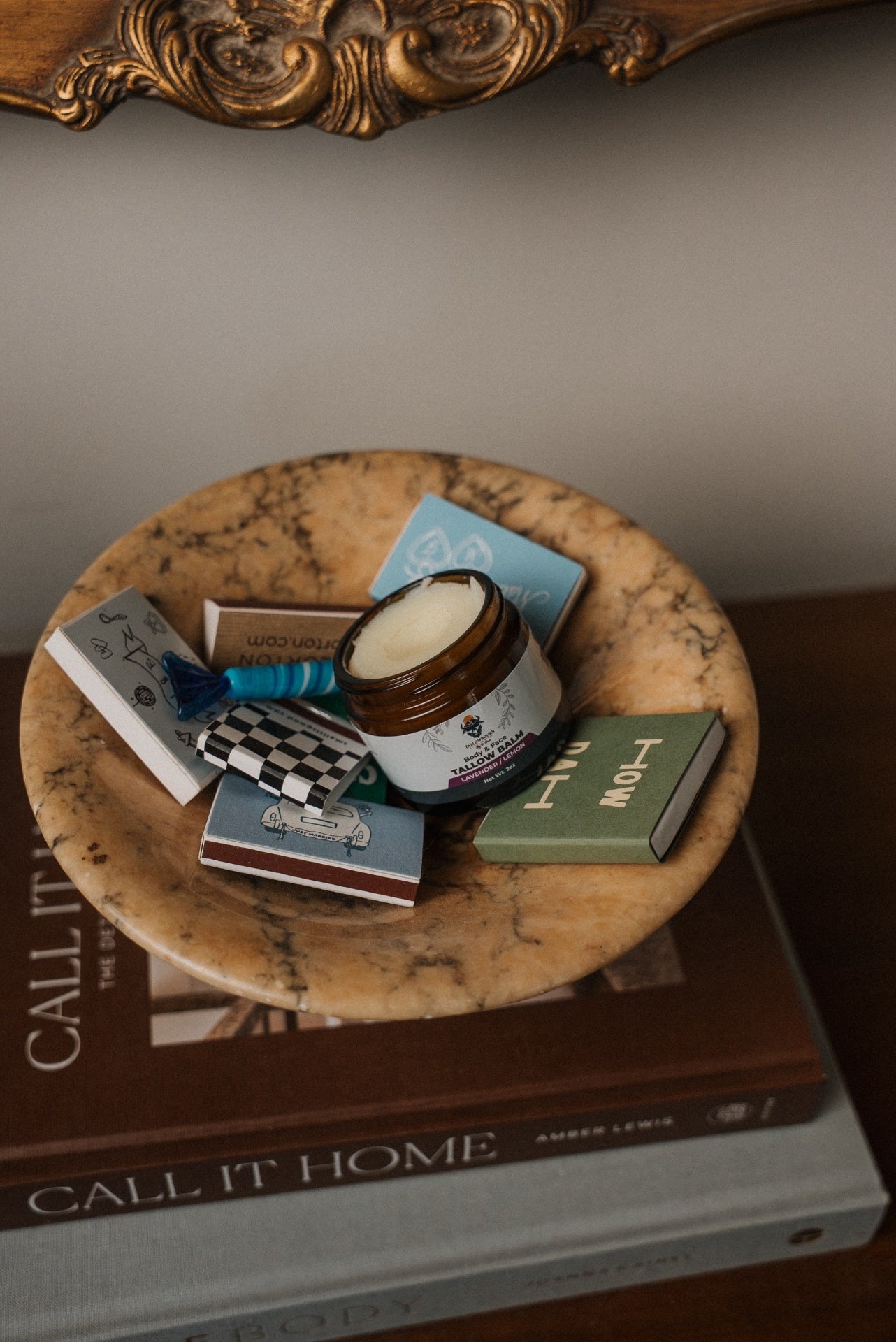
For comparisons to shea and coconut, see our side-by-side breakdown. At Tallowbourn, we also do not sell naked rendered fat as a face serum. Our Grass-Fed Tallow Balm is grass-fed and pasture-raised tallow from US farms, organic jojoba oil, organic beeswax, shea butter, organic honey, and vitamin E. Unscented, vanilla-spearmint, or lavender-lemon. Sizes 1 oz, 2 oz, and 4 oz. Formulated for absorption and comfort, not a thick grease layer.
Does grass-fed tallow change the pore conversation?
Grass-fed (and finished) tallow from U.S. farms is about fatty-acid quality, micronutrients, and cleaner sourcing, not a magic "non-comedogenic" badge. Physical purification matters for odor and impurities. Controlled temperatures and centrifugal separators at a USDA FSIS-inspected U.S. facility pull protein and impurities out. Rushed or dirty processing can leave a meat smell and a heavier feel.
So: grass-fed vs. pore clogging is not a simple yes/no. Better sourcing and clean purification improve how the jar feels. They do not erase individual skin differences or the need for a light hand on congestion-prone faces. If a jar smells like a butcher shop or feels sticky and thick, that is a quality signal, not proof that "beef fat always clogs pores."
How to keep it comfortable
A few habits make the first week smoother.
Heavy application. A big scoop on the face can make almost any rich balm look and feel congesting. Start tiny.
Already congested or oily T-zone. If your forehead, nose, and chin already feel congested or look bumpy, use a lighter hand. Start on drier zones, or body first, then bring a thin layer to the face.
Face vs. body. Body skin is generally more forgiving. Many people who love tallow on arms, legs, and elbows do better with a lighter hand, or a body-first approach, on the face. (although I personally apply to my face morning and night. Also serves as a great after-shave lotion)
Product stacking. Balm plus multiple oils, butters, and heavy creams can overwhelm skin that was fine with one simple moisturizer. Simplify before you blame one ingredient.
Individual variation. Most congestion-prone faces do fine when they keep the layer thin. Your skin is still the final data set.
How to try it (simple and fair)
Sometimes skin is adjusting. Sometimes a product is not a fit. Either way, watch what your skin does and decide from that.
Here is a simple try framework:
- Patch-test if you are worried about congestion. Inner forearm or behind the ear for 24 hours. If you have a known sensitivity to beef or beef derivatives (rare), this step is non-negotiable.
- Start body-side if you are cautious. Dry patches on arms, legs, or hands teach you texture and absorption with lower stakes.
- On the face, use less than you think. Warm a pea-sized amount between clean fingers. Press and pat. Do not rub in a thick coat.
- Prefer damp skin. After cleansing or a light splash of water, a thin occlusive layer helps hold moisture instead of sitting on dry surface oils.
- Keep the rest of the routine boring. One cleanser, one balm. Do not add three new oils the same week.
- Watch for one to two weeks of honest use. Notice how skin feels: comfortable, tight, greasy, bumpy, calm.
- Dial facial use if skin feels overloaded. If your T-zone looks more congested, or skin feels persistently coated, use less on the face or keep the balm on body. Matching the product to the right zones is smart, not failure.
If you are congestion-prone or prone to breakouts, that does not automatically rule tallow out. Keep the layer thin and place it where skin wants it. We are talking moisturization and how skin looks and feels.
The bottom line
Does beef tallow clog pores? Not in our experience. Our family has been using it exclusively for years and have had no issues with clog pores or breakouts. In fact, its been the opposite. Our skin has never been better. We've heard the same from countless long-term customers. Is tallow comedogenic? Old lists will assign ratings; those lists have serious methodological limits. A thin layer is a strong match for many dry and normal skins. If your face runs oilier, use a lighter hand. Body is an easy win either way.
Biocompatibility beats a rabbit-ear scorecard. Formulated well and applied lightly, most people absorb a good tallow balm without drama. If you over-apply on an already shiny T-zone, any rich fat can feel like too much. Dial it back.
Frequently Asked Questions
Does beef tallow clog pores?
For most people using a thin layer of a well-formulated balm, no. Congestion reports usually track with over-application, an already congested T-zone, or a product that simply is not a fit for that person's face. Body use is typically more forgiving than face use. Individual results vary.
Is tallow comedogenic?
You will see it on comedogenic rating lists. Those lists largely come from older rabbit-ear and human-back testing of concentrated ingredients, not finished facial products on real faces. We treat biocompatibility and real-world use as more useful than a single outdated score.
What is tallow's comedogenic rating?
There is not one universal, modern, face-validated number everyone agrees on. Charts recycle older ingredient-level scores from limited test methods. A "tallow comedogenic rating" on a blog graphic is not the same as how a formulated balm behaves on your face in a thin layer. Context beats the number.
Can oily or congestion-prone skin use beef tallow balm?
Yes, with a lighter hand. Use a tiny amount, simplify your routine, prefer dry zones or body first if you are unsure. Oily or congestion-prone here means how skin tends to feel and look, not a medical diagnosis. Comfort wins when the layer stays thin.
Does grass-fed tallow feel different on the skin?
Often yes, in quality and sensory experience. Grass-Fed & Finished tallow from U.S. farms, purified cleanly at a USDA FSIS-inspected U.S. facility (controlled temperatures and centrifugal separators, not a chemical refining stack), tends to feel cleaner and less "meaty" than poorly processed fat. That improves comfort and absorption feel. Keep the layer thin and comfort usually wins.
How should I patch-test if worried about congestion?
Apply a small amount to the inner forearm or behind the ear. Wait 24 hours. If that looks and feels fine, try a rice-grain amount on one small area of the face (or stick to body first). Do not coat the whole face on day one. If the face feels overloaded, dial facial use or keep it on body.
---
Ready to try it for yourself?
If the comedogenicity objection was your main pause, and you want to see how a real formula feels rather than a chart, start with our grass-fed tallow balm. Full filed formula: grass-fed tallow, organic jojoba oil, organic beeswax, shea butter, organic honey, and vitamin E. A little goes a long way.
Simple ingredients. Real chemistry. No BS.
Written by Dr. Dave, Founder of Tallowbourn | PhD, Organic Chemistry