What the Science Actually Says
Yes. Beef tallow works on skin because it overlaps with the fats your skin already makes.
That is the short version. Tallow carries many of the same fatty acids found in human sebum, plus small amounts of fat-soluble vitamins that came with the animal fat. This is not revolutionary. It is lipid chemistry. Tallow did not stop working. The industry moved to cheaper, patentable synthetics and told a better story.
What Is Beef Tallow, Exactly?
Beef tallow is rendered beef fat. That is it.
Not all of that fat starts in the same place. Suet is the hard fat around the kidneys (and the loin cavity). It has less muscle, blood, and moisture stuck to it than the trim and back fat most commodity tallow is made from. That is why suet renders cleaner, firmer, and milder. It is still tallow. It is just a better starting material.
When suet is rendered, it is slowly heated until it melts, strained, and cooled into a shelf-stable fat. People used it for candles, soap, cooking, and skin long before a lotion aisle existed. Then petrochemicals scaled up, synthetics got cheaper, and a lot of "tallow" became whatever leftover fat was cheap that day.
Quality still decides whether you like it on your face. Grass-fed and finished cattle produce tallow with a different fatty acid mix than grain-fed cattle. The depot matters too. Suet versus scrap trim is a bigger quality gap than most labels admit. How it was rendered decides whether the jar is nearly odorless or smells like a butcher shop.
At Tallowbourn we use grass-fed and finished suet tallow from humanely raised cattle on U.S. farms.
Why Does Tallow Work on Skin?
Your skin makes sebum, an oily mix that helps the barrier hold water. Sebum is triglycerides, wax esters, squalene, sterols, and free fatty acids. Among those fatty acids are oleic acid, stearic acid, palmitic acid, and myristic acid.
Beef tallow is mostly triglycerides. Measured samples are typically highest in oleic, palmitic, and stearic acids, with myristic acid present in smaller amounts. That overlap with sebum is the useful part. Your skin is already built to handle this class of lipids. It does not have to invent a new way to live with them.
I would not call that "no barrier rejection." The honest sentence is closer to this: familiar fats are easier to use as an occlusive and emollient film than a silicone or mineral oil that can only sit on top.
Tallow also carries fat-soluble vitamins A, D, E, and K in small amounts because those vitamins lived in the animal fat. They are not a drug dose.
- Vitamin A is involved in normal skin cell turnover.
- Vitamin D has a role in barrier biology.
- Vitamin E is an antioxidant. Our balm also lists vitamin E as an added ingredient.
- Vitamin K is present. I will not dress that up as a tone treatment.
These are not miracle ingredients. They are part of why a well-rendered fat can feel more like skin than a water-heavy lotion.
Tallow moisturizes in two ordinary ways. It is occlusive (it slows water leaving the surface). It is emollient (it fills rough spots so skin feels smoother). Real moisturization is water retention, not slip. A thin layer is all you need. If your face still looks slick after fifteen minutes, you used too much, or you put it on bone-dry skin.
For how tallow compares with shea butter and coconut oil, see our side-by-side breakdown.
Why People Call It Biocompatible
"Biocompatible" is a useful word if we keep it modest. It means the lipid types overlap with what your skin already uses. It does not mean every face loves a rich balm, and it does not mean tallow is identical to sebum. Sebum has wax esters and squalene that tallow does not copy one-for-one.
What it does mean is this. Many lotions lean on silicones, mineral oil, or synthetic emollients your skin does not make. Those can be fine. They are just a different job: sit on the surface, add slip, feel fancy. Tallow is a fat your skin already knows how to handle. On dry or tight-feeling skin, that is often the point.
People with dry, sensitive, or aging skin (skin that is not making enough of its own protective lipids) are usually the ones who notice comfort first. People with oilier skin sometimes do better with a lighter hand on dry zones only.
What About the Concerns?
These are fair questions. I would rather answer them than talk past them.
Is tallow comedogenic?
You will see tallow on comedogenic rating lists. Here is what those lists usually leave out.
The classic scale grew out of a 1979 rabbit-ear method that applied concentrated materials to rabbit ears, not faces. A 1982 human model then tested substances under occlusion on the upper backs of young men. Back skin is not facial skin. The rabbit model is also more sensitive than human skin. Those papers are real. They are also a blunt tool for judging a finished balm on your T-zone in 2026.
The scale also treats ingredients as if you wore them neat, at full strength, alone. That is not how a jar works. Fats, waxes, and oils change each other. How much you use changes the result more than a 1979 number does.
I do not call tallow "non-comedogenic." I also do not treat an old chart as a verdict. A thin layer of a formulated balm is a different experiment than pure fat on a rabbit ear. If your T-zone already runs congested, start smaller, or start on the body, and stop if a new bump pattern tracks with use. Individual skin wins. Speaking from personal experience of our family, we have not experienced any breakouts or issues in the years we have been using it (and we tend to apply more than most-since we have an ample supply).
What about the smell?
Poor tallow smells like a butcher shop. Clean tallow is nearly odorless. Keeping in mind that few things are truly "odorless" and our balm has other natural ingredients like jojoba oil, shea butter, beeswax each with their own subtle scent profiles. The difference is rendering and freshness, not a secret perfume. If a product has a strong meat smell, the fat was rushed or it was not fresh. Skip it.
Isn't there a lack of research?
Yes. There are not many controlled clinical trials on tallow as a cosmetic, in part because a commodity fat does not fund like a patentable synthetic. I know this fairly well having spent 20 years in rare disease research as a synthetic organic chemist. That gap is real. It is not the same thing as "we know nothing."
There is ordinary chemistry on the fatty acids themselves, and there is a 2024 Cureus scoping review on tallow and skin. The authors screened 147 papers and kept 19. They found support for composition, possible benefit, and some therapeutic questions. They also said human cosmetic research is thin, and the side-effect question had the biggest gap. That is the paper. I will not rewrite it as "tallow scored well on safety and efficacy."
So: the literature is limited, the lipid overlap is real, and your skin is still the test that matters.
Does it actually moisturize, or does it just feel slippery?
It moisturizes. Occlusion holds water in. Emollient fats smooth the surface. Those are standard moisturizer jobs, not a tallow miracle.
Dry skin often feels less tight within a few days of honest use. That is comfort, not a guaranteed transformation, and it is not a treatment for a named skin disease.
Who Is Tallow Skincare Best For?
Tallow is not a cure-all. It is a simple, rich moisturizer that fits some skin better than others.
Best fit: Dry or very dry skin. Sensitive or easily irritated skin that does better with fewer ingredients. Aging skin that is making less sebum. Anyone whose barrier feels tight, flaky, or worn down after washing. People who are tired of stacking three lotions and still feel dry by afternoon.
Also a good fit: Normal skin that wants a cleaner jar. Combination skin, with more on dry zones and less on the T-zone. Oily skin can try it, carefully, because a thin layer of a familiar fat is not the same as a heavy coat of a foreign one. It still may feel like too much on a shiny forehead. That is information, not failure.
I do not treat tallow as therapy for eczema, dermatitis, or any other medical condition. People with very dry or reactive skin often like a plain occlusive balm. That is barrier comfort. It is not a diagnosis and it is not a drug claim.
One caveat: If you have a known sensitivity to beef or beef derivatives (rare), patch test first.
If you are unsure, put a small amount on the back of your hand. Then try a small area of the face. Most people know quickly whether the texture agrees with them.
A starting amount on the face is about a pea. That is a start, not a ceiling. Warm it between your fingers or in your palm and press (or lightly rub) it into slightly damp skin. Add more if you still feel tight after a few minutes. We tend to apply more liberally in our family, especially on the body. Technique details live in First Jar on Your Face.
How to Choose a Quality Tallow Product
Not all tallow is the same.
Sourcing: Grass-fed and finished beef has a different fat profile than grain-fed. A 2010 review in Nutrition Journal found more omega-3 fats, a more favorable omega-3 to omega-6 ratio, and higher vitamin A precursors and vitamin E in grass-fed beef. That is dietary fat data, not a face trial. We still choose it because the lipid mix and the sourcing are better. I will not pretend you can clock the difference on your cheeks in a week.
Purification is what separates a clean jar from a butcher-shop one. Our supplier does not use classic wet rendering, and they do not use classic dry rendering. Controlled temperatures and centrifugal separators pull protein and impurities out of Grass-Fed & Finished suet at a USDA FSIS-inspected U.S. facility. Rush the process and you get a meat smell. A lot of commodity tallow is RBD (refined, bleached, deodorized). That can smell neutral too, for a different reason.
Ingredient transparency: A good product lists ingredients you can recognize. Our tallow balm is grass-fed tallow, organic jojoba oil, organic beeswax, shea butter, organic honey, and vitamin E. Unscented, vanilla-spearmint, or lavender-lemon. Jars in 1 oz, 2 oz, and 4 oz. Every item in that list has a job. You will not find a stack of synthetic emulsifiers.
Testing: Ask whether the product is checked for microbial load. We test every batch before it leaves.
Smell and texture: Neutral or pleasant. Smooth on the skin. If it smells like meat or feels thick and tacky, skip it.
The Bottom Line
Beef tallow is useful on skin because your skin already works with this class of fats. That is not ancient wisdom suddenly blessed by a lab. It is why a simple rendered fat can moisturize without a ten-ingredient story.
The resurgence is not all hype. It is also not a miracle. The useful question is not "is tallow good for skin." It is whether it is good for your skin. A week of honest, thin-layer use will tell you more than a comment thread.
If your skin runs dry, tight, or easily irritated, it is a fair thing to try. If you run oily, use less and watch the T-zone. For everyone else, it deserves a real look, not a myth on either side.
We built Tallowbourn around this ingredient because it worked in my kitchen for the person I made it for. Not because we wanted to resurrect something old. Because the chemistry is simple, and a lot of skincare left simple behind.
Simple ingredients. Real chemistry. No BS.
Frequently Asked Questions
Can I use tallow if I have sensitive skin?
Often, yes. Many people with sensitive or easily irritated skin prefer a short ingredient list and a fat their skin already recognizes. That is a comfort observation, not a medical claim, and it is not a promise of less irritation than every synthetic moisturizer. Start with a small amount. If your skin is extremely reactive, or you have a known beef allergy, patch test first.
How often should I apply tallow?
It depends on your skin and the weather. Dry skin may want it morning and night. Normal skin is often fine once a day. Oilier skin can start with once daily, or only on dry patches. Start once a day and adjust by how your skin feels, not by a schedule on the jar.
Does grass-fed tallow make a real difference?
On the fat itself, yes. Grass-fed beef fat tends to carry more omega-3s, a better omega-3 to omega-6 ratio, and more vitamin A precursors and vitamin E than grain-fed fat. That is supported by dietary research, not by a large facial study. We pay more for it because the sourcing and the lipid mix are better. I would not tell you that grain-fed tallow "does not work" on skin.
Can I use tallow around my eyes?
Yes, but keep it tiny. The skin around the eyes is thin. If you put on too much, you can get puffiness or irritation. Start smaller than you think you need.
Is tallow vegan?
No. It is rendered beef fat. If you want a vegan routine, this ingredient is not for you. Plant oils can moisturize well. They do not copy sebum the same way.
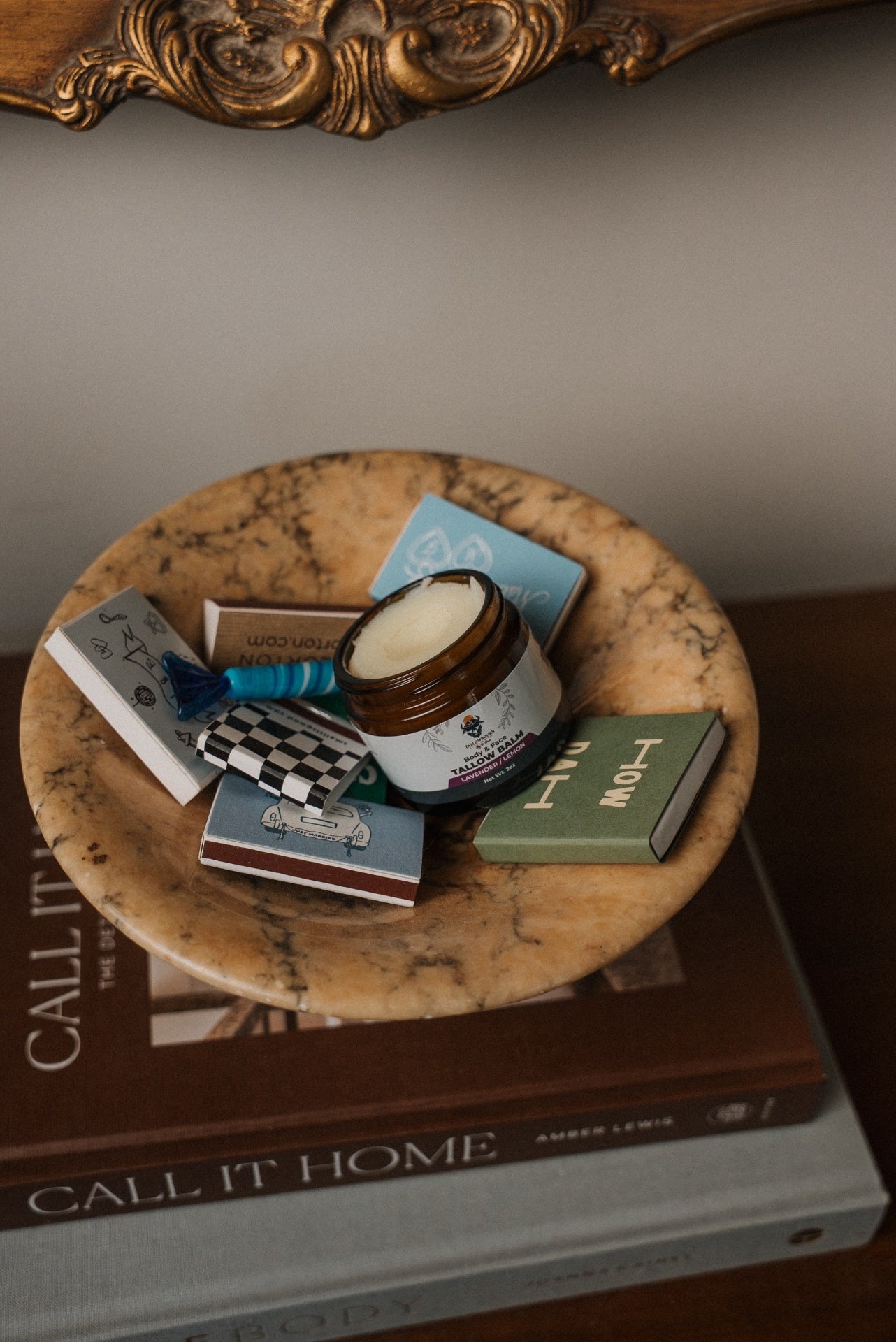
If you want the version we make, start with tallow balm. Full formula: grass-fed tallow, organic jojoba oil, organic beeswax, shea butter, organic honey, and vitamin E. A pea-size amount on damp skin is enough to learn whether it suits you.
Written by Dr. Dave, Founder of Tallowbourn | PhD, Organic Chemistry