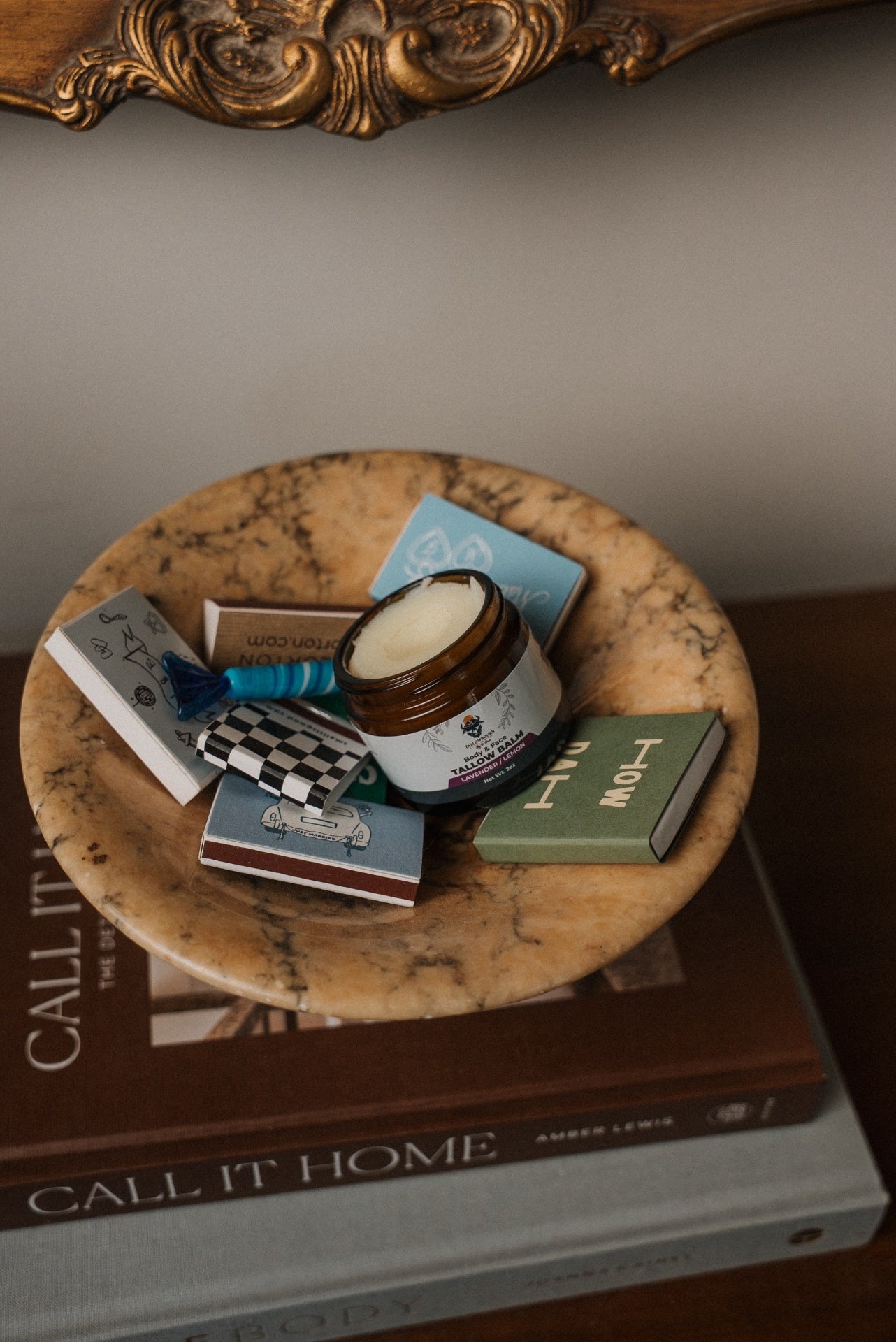
For people unfamiliar with tallow balm (or anything other than watered-down lotion) and how to apply it, this is sometimes how it goes. Opens their first jar of beef tallow for skincare, scoops a generous thumbful, pastes it on a dry face, and wonders if they ordered the wrong product.
You did not. You just used too much, on skin that was too dry, and expected it to behave like a water-heavy lotion.
This post is the practical side of the first jar. Not the full science lecture. Not a miracle story. Just how much to use on your face, when to put it on, and what normal looks like in the first couple of weeks.
If you want the fatty-acid and sebum breakdown first, read Beef Tallow for Skin: What the Science Actually Says. If you want the short origin version of why grass-fed tallow belongs in a routine at all, start with Grass-Fed Tallow for Skincare: Why It Works and How to Start. This one is about technique.
Start smaller than you think
For the face, start with a pea-size amount.
Not a grape. Not a spoon. A pea.
As you get more used to a personal preference, you can always apply more. We tend to apply liberally in our family.
Warm it between your fingertips (or palm) until it softens to your liking. Press it in. Do not scrub it around like a thick cream on a beach day. Pressing helps it spread thinner and settle into the surface instead of sitting in greasy islands.
If your cheeks still feel tight after a few minutes, add another half pea. Build up. Do not start at the top and try to wipe the excess off later. That is how people decide tallow is "too heavy" on day one.
Body skin can take more. Hands, elbows, shins, and heels are not as fussy as the T-zone. Face first, restraint first.
Our Grass-Fed Tallow Balm is anhydrous, meaning there is no water padded into the jar. The formula is grass-fed tallow, organic jojoba oil, organic beeswax, shea butter, organic honey, and vitamin E. You can get it unscented, vanilla-spearmint, or lavender-lemon, in 1 oz, 2 oz, or 4 oz jars. A little goes further than a pump lotion because you are not paying for dilution. That is a feature. It also means old lotion habits will overshoot the mark.
Damp skin beats dry skin
Put balm on skin that is still slightly damp.
After you wash your face, pat until you are not dripping, then apply while there is a light film of water left. The balm helps hold that water against the skin. That is occlusion doing honest work. You are trapping moisture that is already there, not trying to invent hydration out of thin air.
If you apply to bone-dry skin in a dry room, the finish will feel heavier and the absorption window will feel longer. Same jar. Different setup.
A simple order that works:
- Cleanse gently.
- Pat, do not sandpaper-towel your face.
- Warm a pea of balm.
- Press over face and neck.
- Leave it alone for a few minutes before clothes or pillowcases get involved.
If your cleanser strips you raw, the balm is fighting uphill. A tallow-based bar like our Grass-Fed Tallow Soap cleans without the squeaky, tight feeling a lot of detergent bars leave behind. Tight skin after washing is not "extra clean." It is a barrier asking for help.
Morning, night, or both?
Most people do best starting at night.
Nighttime gives the balm hours without makeup, desk dust, or a winter scarf rubbing your chin. You also get honest feedback in the morning: softer, less tight, or still greasy because you used too much.
Morning use is fine if your skin is dry and your day is not a full-face makeup marathon. Use less in the morning than at night.
If you spend real time outdoors, balm is not a mineral sun balm. For mineral coverage with a tallow base, that is what Tallow Sun Balm is for. Different job. Do not make the plain balm pretend to be zinc oxide.
AM and PM both can work once you know your dose. I would rather you master night use for a week than coat your face twice a day and blame the formula.
What the finish should feel like
Tallow balm will not finish like a serum.
Serums are built to disappear and leave a thin, sometimes sticky film. A well-made tallow balm softens, spreads, and leaves skin comfortable. Comfortable is not the same as invisible in the first two minutes.
After you press (or lightly rub) it in, give it five to ten minutes. The surface should feel nourished, not wet. If you can draw oil circles (lol) with one finger across your cheek after fifteen minutes, you used way too much or applied to fully dry skin.
What I look for after a week of steady use:
- Less tight feeling after washing
- Makeup or morning air feels less abrasive
- Flaky patches calm down instead of relocating
- You stop hunting for a second moisturizer at 3 p.m.
What I do not look for: glass-skin filters, overnight wrinkle erasure, or a face that looks airbrushed under bathroom LEDs. That is marketing language. Skin is an organ, not a product demo.
That short list is why it is not 70% water and perfume. For more on how we build the jar, see What's Actually in Your Tallow Balm?.
The greasy week is usually technique
A greasy first application is the most common question I get from new users.
Common causes:
Too much product. Drop back to a pea or half pea. People coming from thick night creams often double the dose out of habit.
Bone-dry application. Add the damp-skin step. It changes the feel more than people expect.
Layering on top of three other oils. If you are still using a face oil, a butter cream, and then tallow, you built a stack. Strip the routine down. One balm can replace a pile of half-working moisturizers. I wrote about that habit in Your Skincare Routine Is Probably Too Complicated.
Warm rooms and hot hands. Soft balm spreads fast. In summer, use even less and warm a smaller scoop.
Expecting lotion slip. Lotion slip comes from water and emulsifiers. Anhydrous balm has a different glide. Different is not defective.
If your skin is truly breaking out in a new pattern, stop and reassess. Tallow is not magic for every face. People with dry, sensitive, or irritated skin often do well with it. That is the honest sentence. "Works for every skin type on earth" is not a sentence I will write.
Smell-wise, grass-fed and finished tallow that is properly rendered should be mild. A strong beef-stew odor usually means a quality or rendering problem, not a personal failing. Grass-Fed & Finished tallow from U.S. farms is purified at a USDA FSIS-inspected U.S. facility. Controlled temperatures and centrifugal separators pull protein and impurities out. The fatty acid profile sits close to human sebum, and clean purification keeps the jar usable on a face, not just a boot.
What I do not promise
I do not promise that beef tallow for skincare cures eczema, psoriasis, rosacea, or acne. Those are medical conditions, and we don't make medical claims. Some people with dry, reactive skin find a simple tallow balm more tolerable than fragranced lotions. If you want first-hand customer stories, our reviews are the place. That is support for the barrier. It is not a diagnosis and it is not a drug claim.
Literature on tallow specifically is thinner than the internet implies. The useful part is not mystical. Fatty acids, occlusion, and a simple formula without a perfume cloud. Some of the online lore is nostalgia marketing. Some of it is ordinary lipid chemistry. I would rather you know which is which than sell you a legend.
A simple face routine that works with tallow
You do not need ten steps.
Night
- Cleanse with a gentle bar or a mild wash.
- Optional: a plain hydrating step if you already use one and like it (keep it boring).
- Pea-size tallow balm on damp skin.
- Lip balm if your lips crack. Our Grass-Fed Tallow Lip Balm is the same idea in a smaller job.
Morning
- Rinse or cleanse lightly if you need it.
- Smaller amount of balm if your skin runs dry.
- Mineral sun protection if you are going outside.
If you want the cleanest on-ramp without guessing jars, the Tallow Skincare Starter Kit pairs balm with soap, lip balm, and deodorant so you are not mixing five brands with five philosophies. If you only want to test scents before committing, the Tallow Balm Sample Pack exists for that reason.
That is the whole plot. Small amount. Damp skin. Night first. Give technique a week before you declare the jar guilty.
I never set out to write application manuals. I set out to stop my mom's skin from feeling tight by noon. The dose mattered then, and it still matters now.
If you want the company story behind the first kitchen jar, it is on our About page.
Frequently Asked Questions
How much beef tallow balm should I use on my face?
Start with a pea-size amount for the whole face. Warm it between your fingers and press it in. Add a little more only if your skin still feels tight after a few minutes.
Should I apply tallow balm to wet or dry skin?
Slightly damp skin is better. Pat dry after cleansing, then apply so the balm can help hold water at the surface instead of sitting on fully dry skin.
Is it normal for tallow balm to feel greasy at first?
A short adjustment period is common, especially if you used too much or applied to dry skin. Cut the dose in half and use the damp-skin method before you decide the product is wrong.
Can I use beef tallow for skincare every day?
Yes. Daily use, especially at night, is how most people judge whether it suits them. Consistency tells you more than one heavy application.
Will tallow balm clog my pores?
Not everyone tolerates rich balms the same way. Use a thin layer, keep the rest of your routine simple, and stop if you see a new breakout pattern that does not settle with better technique.
Can I wear makeup over tallow balm?
Often yes, if you use a small amount and give it several minutes to settle. Morning doses should be lighter than nighttime doses.
How long until I notice a difference?
Many people notice less tightness within several days. Give steady use one to two weeks before you judge barrier comfort. We do not promise dramatic overnight transformations.
Written by Dr. Dave, Founder of Tallowbourn | PhD, Organic Chemistry