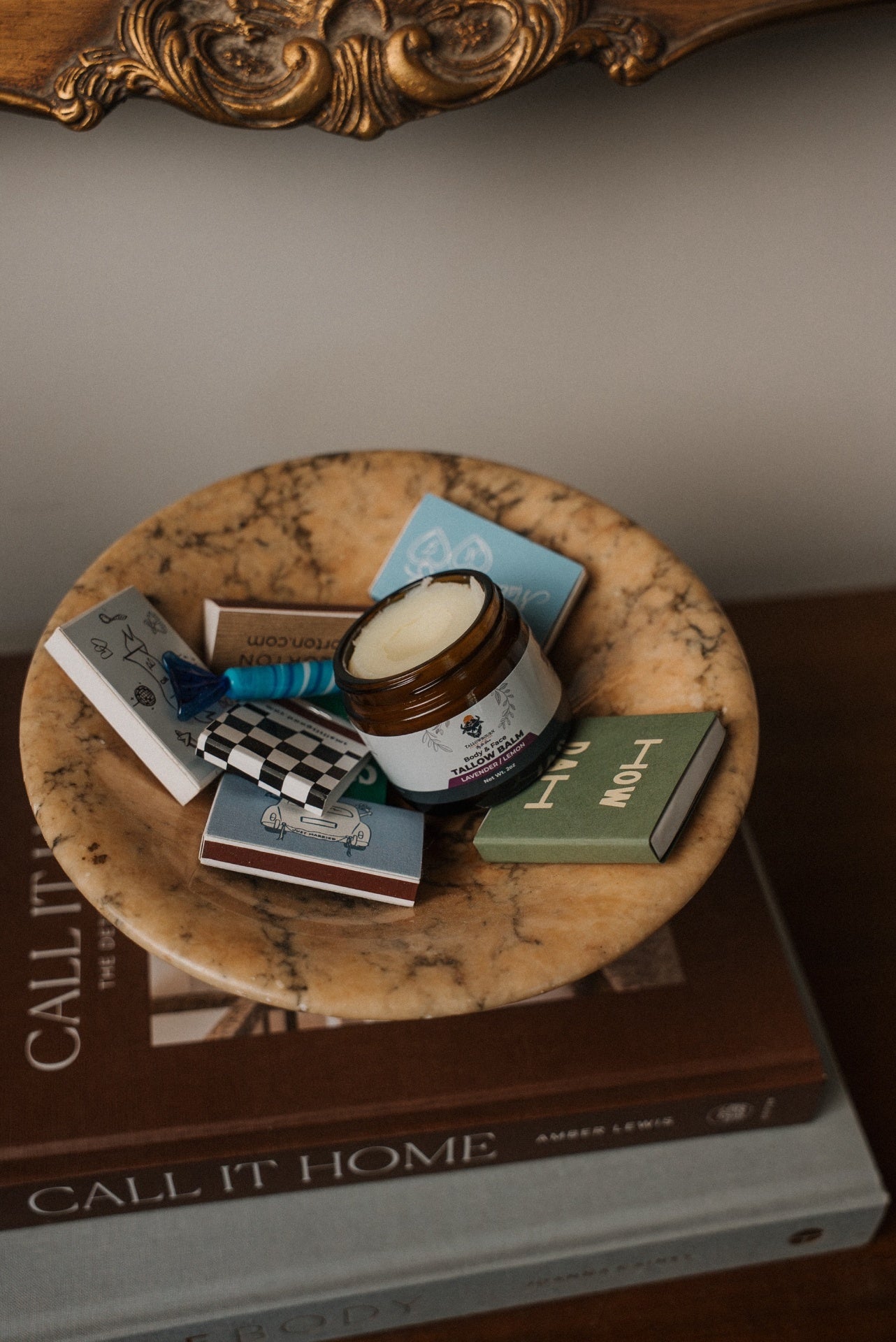
Yes, the tallow balm you use on your face works as a body balm, and hands, heels, and elbows are where it often matters most. Those spots make little or none of their own oil and take more washing and wear than your face. Give them a bit more, on skin that is still slightly damp.
Your hands and heels are built differently than your face
A 2024 review of human sebaceous glands in the International Journal of Molecular Sciences describes them as abundant on the face and scalp and present on most skin "except the palms and soles." Your face gets a steady supply of its own oil. Your palms and soles get none.
Heels add a second problem. A 2015 study in the Journal of Foot and Ankle Research found that the skin on the bottom of the foot has properties unlike skin anywhere else, including a thick outer layer. When the researchers measured dry heel skin, it held less water, was less elastic, and had a rougher surface than normal foot skin.
The backs of your hands do have some oil glands, but they get scrubbed all day. Every soap and hand wash is a surfactant. Its job is to lift oil off a surface so water can carry it away, and even a gentle bar takes some of your own oil along with the grime. Wash your hands ten times before dinner and you have stripped them ten times.
Those three facts shape everything below.
What a waterless balm does on thick, dry skin
Tallow is a fat, mostly triglycerides. Spread thin, it forms a soft film that slows the water already in your skin from leaving. Beeswax helps that film stay put. Honey does a different job: it is a humectant, so it holds water. Our six-ingredient balm has both.
On a heel or a knuckle, that film has a lot of dry, thick skin to cover and nothing underneath making oil to help. That is exactly where a rich, waterless balm earns its spot. (Why a water lotion fades faster is on our dry skin page.)
Timing matters more on the body than people expect. A dermatology review on moisturizers, Moisturizers: The Slippery Road, notes that occlusive oils work best on slightly damp skin, especially after a bath. A film can only hold in water that is there. Right out of the shower, pat dry and go.
Hands: backs, knuckles, and cuticles
Put the balm where the dryness is. For most people that is the backs of the hands, the knuckles, and the skin around the nails, not the palms. Palms are thick and they grip things. A coat there just makes the steering wheel slick.
Start with a pea for both hands. Rub it between your palms only long enough to melt it, then work it into the backs and push what is left into your cuticles. If your hands still feel tight a minute later, add a little more.
The best time is after the last handwash of the night, when the balm can sit for hours instead of minutes. During the day, a 1 oz tin in a desk drawer, car console, or gym bag covers the stretch after the third or fourth wash.
Heels and feet: do them at night
Heels can take more than any other spot. Go a bit past a pea per heel and press it in with your thumb rather than skating it over the surface. Then pull on a pair of cotton socks. The socks keep balm off your sheets and keep you from sliding on a wood floor, and the balm gets all night on the thickest skin you have.
Be patient. Thick, dry heel skin takes regular use for you to feel a difference in how it looks and feels. One night will not do it.
Elbows, knees, and shins
Shins are the spot most people forget until long hot winter showers leave them dry and tight. Do them while your legs are still damp: warm a small amount in your palms and sweep it down each shin in one pass. A thin layer is the goal. Anything that stays shiny after a few minutes was more than you needed.
Elbows and knees want a dab each. Here is an easy habit: whatever is left on your hands after your face, rub it into your elbows.
Which jar to pick for body use
Body use goes through more balm than a face routine, so size up. The 4 oz jar makes the most sense if you are doing heels and shins every night. The 2 oz suits a hands-and-elbows habit.
All three sizes come in Unscented, Vanilla & Spearmint, and Lavender & Lemon. I made the first balm for my mom, and she still uses the 4 oz Lavender & Lemon as her go-to. On the body, scent is a personal pick. On your hands, it ends up near your nose all day, so choose one you actually like smelling.
Frequently Asked Questions
Will it leave my hands greasy at work?
During the day, a rice grain worked into the knuckles and cuticles is usually enough without leaving prints on paper. If you overshoot, press the backs of your hands together to spread it out instead of wiping it on your pants.
Does tallow balm stain sheets or socks?
A thin layer that has had a few minutes to settle rarely leaves marks. My wife tends to go pretty heavy before bed and we haven't noticed any issues. The time it has to absorb the better, but don't over think it. The Balm is mostly fat, so a normal warm wash with regular detergent lifts it out of cotton.
Can I use the jar on my lips too?
Some people do. The 1oz tin is great for that if traveling. But I strongly prefer to use our tallow lip balm for lips. It is made for that job and fits in a pocket. Keep the jar for face and body.
Related reading
- How much tallow balm to use on your face: the face amount, which is smaller than anything on this page.
- Post-workout skin: sweat, hot water, and a bar that works: the shower that comes before the balm.
- Tallow, shea butter, and coconut oil: what each one does best: the fatty-acid chemistry in depth.
Written by Dr. Dave, Founder of Tallowbourn | PhD, Organic Chemistry