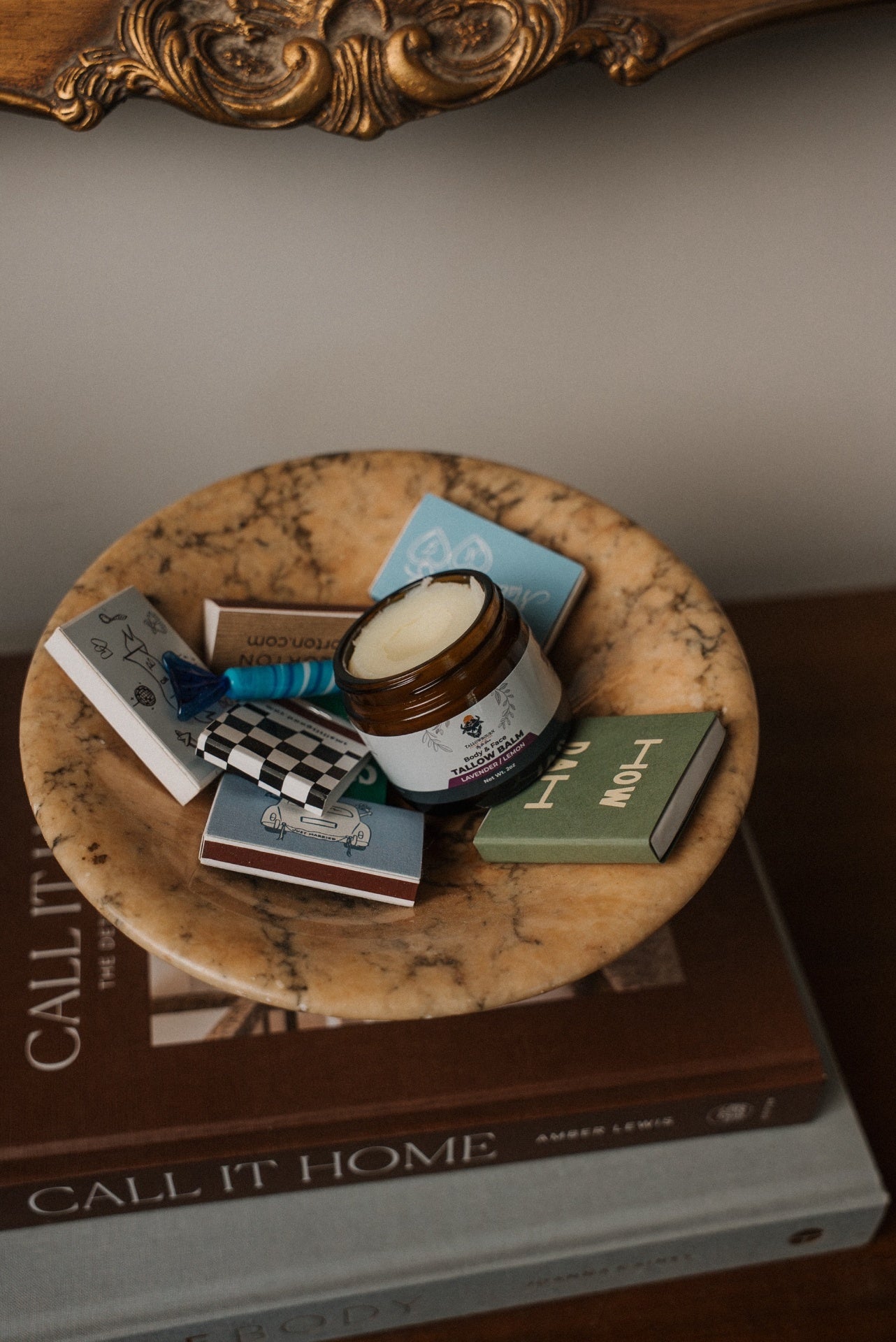
Can you use beef tallow on hair? Yes. A small amount of tallow balm smooths the surface of hair, calms frizz and flyaways, and leaves hair or a beard softer without looking oily. The easiest way to use it is right after a shower, with the same jar you already use on your face and body.
What tallow does for hair
A healthy hair fiber is wrapped in a cuticle, overlapping cells that sit like roof shingles. The surface of those cells carries a thin layer of lipids, and that fat is what makes healthy hair shed water and slide past its neighbors.
That layer doesn't last. Dermatologist Maria Fernanda Reis Gavazzoni Dias describes it in Hair Cosmetics: An Overview: repeated washing, rough drying, friction, sun, and alkaline chemical treatments all strip lipids from the cuticle. The surface goes from water-repelling to water-attracting and picks up a negative charge. You see the result as tangles, static, and frizz.
The same review lists oils and waxes among the ingredients conditioners rely on to reduce friction, cut frizz, and make hair easier to comb. Putting a thin film of fat back on the cuticle is the core of conditioning, and that is what tallow does.
Here is what that gets you:
- Less frizz and fewer flyaways. A fat-coated surface holds less static and doesn't fight the strands next to it.
- Softer, smoother hair. Strands glide instead of snagging, so hair feels softer and towels and brushes catch less.
- A healthy sheen. A smooth cuticle reflects light more evenly than a roughed-up one.
- A softer beard. Coarse beard hair softens, and the skin underneath gets the same balm your face does.
Why tallow and not just any fat? Tallow is made mostly of oleic, palmitic, and stearic acids. Those are among the same fatty acids in sebum, the oil your own scalp makes to coat each hair. I cover that overlap in more detail in Beef Tallow for Skin: What the Science Actually Says. Our balm adds beeswax, a wax, plus jojoba oil and shea butter, so it brings both kinds of conditioning ingredients in one jar.
Why a balm works better than a bottle of oil
Tallow is a mixture of triglycerides, and they don't all melt at the same temperature. Kathleen Morlok's Kansas State University report on tallow explains how part of the fat stays solid while part is liquid. That is why tallow holds its shape in the jar but softens fast between warm hands.
For hair, that matters. A liquid oil runs, and it's easy to pour on too much. A balm only goes where your hands put it, and it stays there instead of sliding down to your collar. A trace melted on your palms covers more hair than you'd expect.
How I use tallow balm for hair after a shower
I apply our grass-fed tallow balm to my body and face, then run my hands through my damp hair. Whatever balm is left on my hands does the job. For me, wet or towel-dried hair gives by far the best result.
By then the balm is a thin film on my palms, so it spreads evenly instead of landing in one spot. A chunk of solid fat worked into dry hair just sits on top and looks greasy.
If you'd rather take a small dab straight from the jar, that's fine. Warm it between your palms first.
Got a beard? Same move on the damp hairs. Keep it off the lip line, and let everything dry before you decide whether you need more. Usually you won't.
Tallow for fine, thick, or curly hair
Fine hair needs less fat than thick or coarse hair. The amount that gives coarse hair a comfortable finish can leave fine strands flat. Curly hair can often take a bit more. Hair that is dense but made of fine strands still counts as fine here, curls included.
Length matters too. A short haircut and a head of long curls don't give the same dab the same amount of hair to cover, so start small and add only if you need it. If you already use a leave-in or styling cream, keep it the same while you try the balm so you can tell what changed.
Washing tallow balm out of hair
Your normal shampoo takes tallow out. Shampoo surfactants have one end that grabs oil and one end that likes water, so they pull fat off the hair and carry it away in the rinse. Plain water can't do that, because fat doesn't dissolve in it.
If you overdid it, a second lather usually finishes the job. Don't judge the first wash by the foam. Oil suppresses bubbles, so the first lather can look weak even while it's lifting most of the balm, and the second one foams up once the hair is clean.
Frequently asked questions
Does this replace conditioner?
Keep the conditioner that works for you. Tallow balm is a leave-in finish after you wash and condition, not a swap for a rinse-out conditioner.
Which scent is best for a beard?
Our face and body balm comes in Unscented, Vanilla & Spearmint, and Lavender & Lemon. Choose Unscented if you don't want added scent right under your nose.
Does tallow add moisture to dry hair?
It doesn't add water. Our balm contains none. What it does is put back the oily film that keeps hair from soaking up water as easily, which is a different job from adding it.
Related reading
- How much tallow balm to use on your face covers facial dosing.
- Post-workout skin and the after-shower routine covers washing and toweling off.
- Tallow, shea butter, and coconut oil compares their fatty-acid chemistry for skin.
Written by Dr. Dave, Founder of Tallowbourn | PhD, Organic Chemistry